HOW TO SELECT THE RIGHT HUMIDIFICATION SYSTEM
« Humidifying = adding water vapour into the airflow »
CLASSIFICATION OF HUMIDIFIERS
A humidifier increases the humidity level of the air. Two main technologies are distinguished according to the source of the heat for vaporisation, resulting in different operating costs.
Adiabatic humidification
Water evaporates upon contact with the air. The energy required for evaporation is absorbed directly from the airstream, which results in air cooling. If required, the building heating system compensates for this cooling effect.
The evaporation energy is supplied by the boiler system (gas, oil, heat pump, etc.).
Isothermal humidification
Steam is generated directly within the humidifier and then injected into the air. The humidifier itself provides the energy for vaporisation, with a higher energy cost than that of the heating battery.
Humidifiers can be divided into three main categories:
- Adiabatic humidifiers without recycling
- Rotary atomiser Microniser
Adiabatic humidifiers with recycling
- System with tank and water recirculation
- Isothermal steam humidifiers
- Electrode steam generator
- Resistance steam generator
- Gas steam boiler
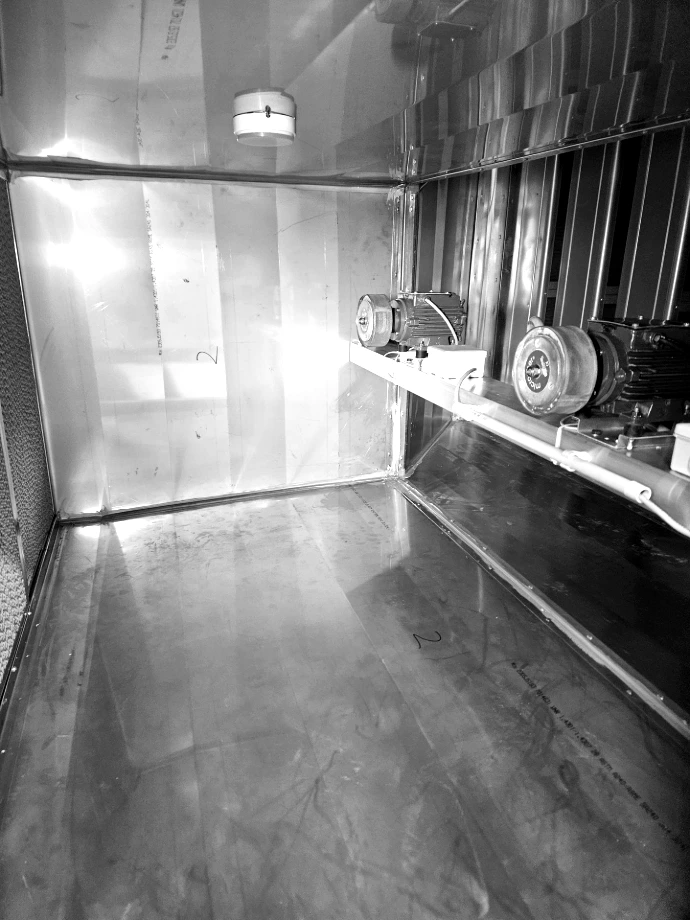
Adiabatic humidifier without recycling
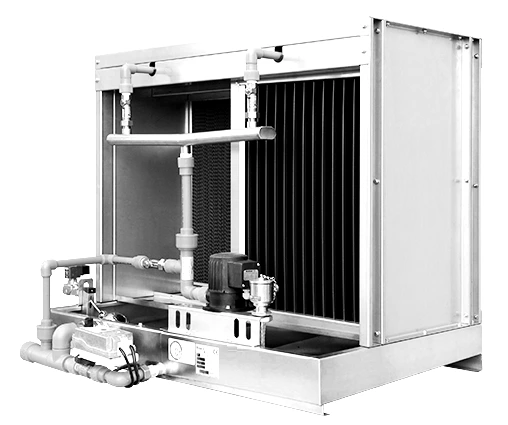
Adiabatic humidifier with recycling
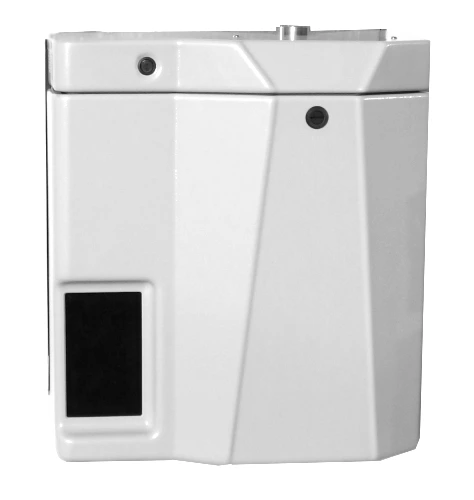
Steam humidifier
HYGIENE & WATER SAFETY
Hygienic safety depends as much on the chosen technology as on the adherence to good maintenance practices by the operator.
Steam humidifiers
Steam systems present a low hygienic risk and generally require few specific measures, apart from proper maintenance.
Adiabatic humidifiers without recycling
The absence of stagnant water significantly limits bacterial growth. The quality of the water and its treatment remain essential to ensure safe and reliable operation. Different water treatment techniques exist and will be recommended based on the acceptable risk threshold.
Adiabatic humidifiers with recycling
The presence of a retention tank with stagnant water increases the risk of bacterial growth. Antibacterial treatments are therefore essential, which constitutes a significant limitation for this type of system.
REGULATION
The humidifier operates under the control of the BMS, which allows humidification and sets the humidity setpoint.
Steam humidifiers
Steam is injected directly into the air after heating. The humidifier provides energy to the airflow, with a risk of overconsumption when humidification and cooling operate simultaneously.
Adiabatic humidifiers without recycling
Humidification occurs without direct heat input. The building's heating system effectively provides the necessary energy, and the humidifier ensures precise humidity control. This technology offers the simplest, most responsive, accurate, and particularly economical regulation.
Adiabatic humidifiers with recycling
These systems require preheating and post-heating phases to operate. Their regulation via the dew point is more complex and can lead to additional energy consumption.
PRE/POST HEATING BATTERIES

With a steam humidifier, the heating battery must provide the necessary energy to reach the dry temperature. The energy for humidification is consumed by the humidifier itself.
With an adiabatic humidifier, all the energy is effectively supplied by the heating battery, while the humidification remains isenthalpic.
A post-heating battery is only necessary for adiabatic humidifiers with recycling. Just like steam humidifiers, non-recycling humidifiers such as the Microniser can operate without a post-heating battery and can be easily integrated into a humidification unit or in a supply duct.
FOOTPRINT

Steam humidifiers can be installed directly in ducts, making them suitable for small spaces. Gas steam boilers require a dedicated technical room.
Adiabatic humidifiers are installed in a sealed casing. Non-recycling systems, such as Microniser, easily integrate into air handling units or in supply ducts, while recycling systems require installation between preheating and post-heating batteries.
ENERGY EFFICIENCY
For humidification, we distinguish between energy consumption and cost. The energy supplied to the airflow does not depend on the type of humidifier, but the energy cost will vary significantly depending on the energy source used.
The energy required for humidification is divided into two parts:
- mechanical energy (pumps, atomisers), which is negligible;
the energy for vaporising water, whichis high (~0.73 kWh/kg of water heated from 10 °C to steam). Its cost varies greatly depending on the technology:
- In adiabatic humidification, the energy is supplied by the building's heating battery (gas or oil), with a low cost.
- In electric steam humidification, the energy is directly produced by the humidifier, with a cost typically 3 to 5 times higher than gas.
Steam humidifiers use a lot of energy to evaporate water. The main energy losses come from the deconcentration of hot water, maintaining the tank at high temperature, and control auxiliaries.
Adiabatic humidifiers consume very little energy, as the energy supply to the airflow is provided by the heating battery. Energy losses come from the auxiliary consumption of the humidifier (atomiser, pump, etc.), but they remain very limited. The energy cost is always very low, as these humidifiers allow energy to be supplied via the most efficient source. Furthermore, the adiabatic cooling effect can reduce the use of the cooling battery during the interseasons.
Moreover, some steam or adiabatic systems with recycling can lead to simultaneous operation with the cooling battery, significantly increasing consumption. This phenomenon is avoided with adiabatic systems without recycling, where the regulation remains decoupled from the other batteries.
WATER CONSUMPTION

The cost of water generally remains marginal in the financial analysis of humidification systems, even though consumption is becoming an increasingly monitored criterion.
With a steam humidifier, water losses mainly come from the deconcentration of the tank, with the discharge of hot water concentrated in salts and minerals.
With a non-recycling adiabatic humidifier, consumption depends on the evaporation efficiency in the airflow and the operating conditions (setpoint, air speed, casing design, droplet distribution, type of separator).
With a recycling adiabatic system, consumption is dominated by the deconcentration of the retention tank; it can be 3 to 10 times higher than that of other types of humidifiers.
WATER QUALITY
“Humidifying = risk of injecting bacteria and dust into the air”
The quality of water must be defined by reconciling two objectives: ensuring hygienic operation and controlling operating and maintenance costs.
Adiabatic humidifiers without recycling use a flow of fully vaporised water. Salt deposits on the components require maintenance, often limited by the use of osmosis water.
Recycling systems consume more water for deconcentration. They generally operate with softened water and require more frequent maintenance.
Steam humidifiers guarantee sterile steam but generate limescale deposits in the generator. Resistance versions can use osmosis water to reduce maintenance, unlike electrode systems which require a minimum conductivity to operate.
MAINTENANCE

Proper maintenance is essential for the proper functioning of all types of humidifiers.
Steam humidifiers require regular maintenance of the tank and, depending on the technology, the replacement of electrodes or resistors, with generally heavier maintenance for electrode systems.
Adiabatic humidifiers without recycling require limited maintenance, mainly related to mechanical components and cleaning of the casing if the water is not osmosis.
Recycling systems require more frequent maintenance to ensure hygiene, including heavy cleaning and disinfection operations.
PRE-SIZING

For steam humidifiers, the installed power is approximately 750 W per kg/h of steam, with a steam ramp sized according to the supply duct.
A 280 W Microniser atomiser can process up to 70 L/h (≈ 4 W per kg/h). The number of atomisers depends on the required steam flow rate, the air flow rate, and the casing, averaging 1 atomiser for 10,000 m³/h.
Quickly estimate the solution suited to your needs
COSTS:
INVESTMENT + OPERATION
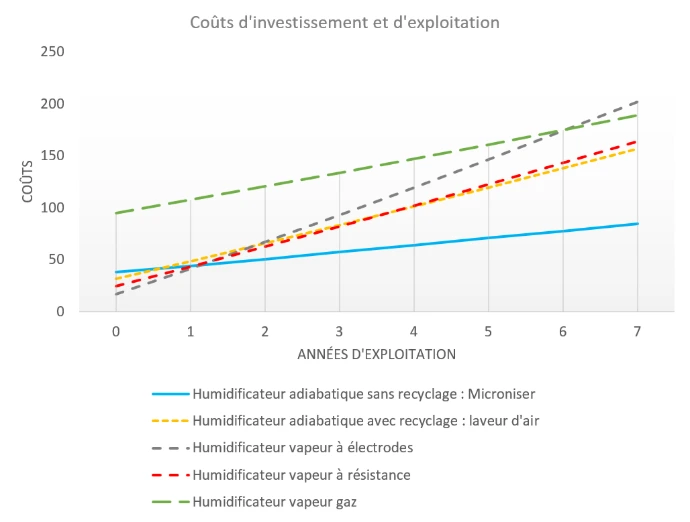
The choice of a humidifier is often made based on the initial investment, whereas the relevant criterion is the total cost: investment + operation.
Performance and operating conditions strongly influence the total cost, with the investment quickly becoming marginal compared to energy and maintenance costs.
Microniser also offers a Full Service option with no initial investment, based on a monthly payment.
SYNTHESIS OF SELECTION CRITERIA
Type of humidifier | Investment | Operating costs | Maintenance costs | Footprint | Regulation | Hygienic risk | For air flow rate |
|---|---|---|---|---|---|---|---|
| Adiabatic without recycling: Microniser | Medium | Low | Low | Medium | Simple | Low | >10000 m³/h |
| Adiabatic with recycling: air washer | Medium | Low | High | Medium | Complex | High | >10000 m³/h |
| Electrode steam | Low | High | High | Low | Simple | Low | <3000 m³/h |
| Resistance steam | Medium | High | Medium | Low | Simple | Low | <10000 m³/h |
| Gas steam | High | Low | Medium | High | Simple | Low | >10000 m³/h |
Steam humidifiers offer good hygienic guarantees but with a high operating cost related to electricity. Their use should therefore be sized as accurately as possible, suitable for small buildings.
Adiabatic humidifiers with recycling are more energy-efficient but require ongoing monitoring and maintenance to manage hygienic risks.
Adiabatic humidifiers without recycling (Microniser) combine hygienic performance and energy efficiency, and are particularly suitable for large centralised installations, when space allows.
For more information regarding the design of your humidifier, we also invite you to visit the site energie+.